
The Solo Immigration Firm: AI Integration – A Look at Operations Before and After
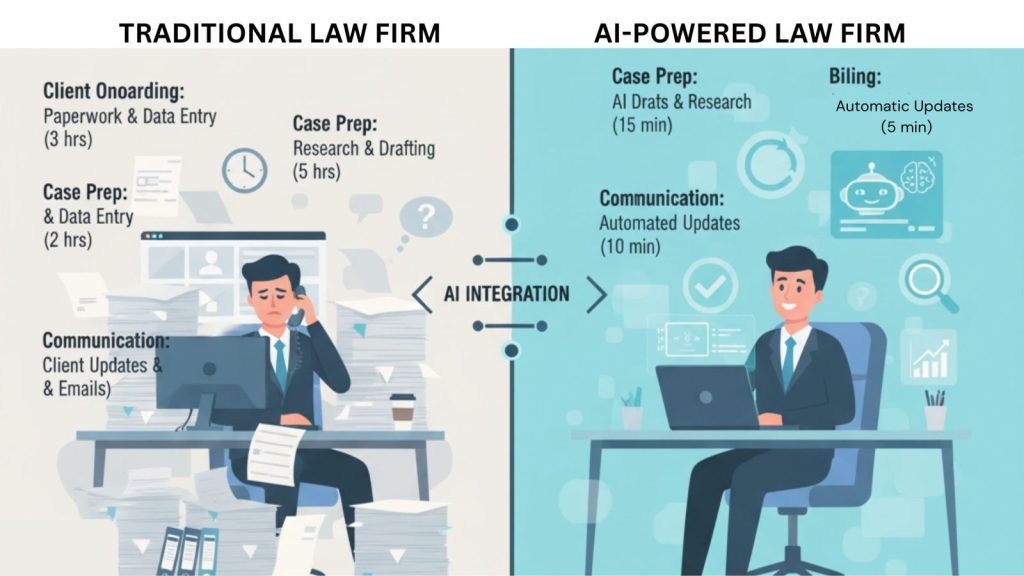
Running an immigration law firm has traditionally been a balancing act between practicing law and managing people.
Attorneys don’t just serve clients—they also manage intake staff, train paralegals, coordinate billing teams, and oversee endless administrative details. The result? Time and money lost to operations instead of legal work.
For most firms, this multi-staff model has long been considered the only way to scale. You hire intake specialists to handle leads, paralegals to prepare documents, admins to manage calendars, and finance staff to handle billing.
But every additional role means additional payroll, more supervision, and a higher risk of bottlenecks when people are unavailable, sick, or overwhelmed. In immigration law—where deadlines are strict and clients are anxious—any delay can damage your reputation or even cost a case.
Today, however, a new model is emerging. Powered by AI automation, immigration law firms are moving toward a future that’s leaner, faster, and infinitely more scalable:
The One-Attorney, One-AI Law Firm.
Before AI: Multi-Staff Dependency
For decades, immigration firms have relied on large teams to stay operational. Each role was essential to keep cases moving—but also a potential source of delay, error, and cost.
Let’s take a closer look at what “before AI” looked like for most small and mid-sized firms:
1. Intake & Lead Management
Before AI, staff manually responded to inquiries through phone calls and emails.
- Intake specialists collected client information through forms or interviews.
- Staff qualified leads, followed up on missing details, and sent fee quotes manually.
- Prospective clients waited hours—or days—for responses.
This manual intake process wasn’t just slow; it cost firms leads. Immigration clients, often seeking urgent help, would contact multiple attorneys and hire whichever one responded first. Without automation, firms lost valuable business simply because intake was too human-dependent.
2. Case Evaluation & Documentation
After intake, paralegals or assistants reviewed documents and determined case eligibility.
- Staff cross-checked visa requirements manually.
- Files were reviewed one by one.
- Errors or missing paperwork caused repeated follow-ups with clients.
In short, every evaluation required hours of staff time and constant oversight from the attorney.
3. Contracts, Billing, and Communication
Once clients agreed to move forward, more staff took over:
- Contract managers prepared retainer agreements manually.
- Admins generated invoices, tracked payments, and sent reminders.
- Case managers handled follow-up calls, scheduling, and client updates.
All of these steps relied on human coordination. If any person missed an email or forgot to follow up, the process stopped.
4. Internal Bottlenecks
When one employee was unavailable, the entire operation slowed.
Paralegals couldn’t proceed without intake data. Attorneys couldn’t file without complete documents. Managers couldn’t track performance without manual reports.
Each layer of staff added time, complexity, and risk—making growth expensive and operational efficiency nearly impossible.
The True Cost of Manual Operations
For a typical immigration law firm:
- 40–60% of revenue goes to staff salaries and benefits.
- Attorneys spend 20–30% of their time managing teams instead of handling legal strategy.
- Clients experience delays because tasks are passed from one person to another.
These inefficiencies don’t just eat into profits—they limit how much a firm can grow. A small firm can only take on as many cases as its staff can handle.
Scaling means hiring more people. More people means more payroll, more management, and more risk.
The model simply doesn’t scale efficiently.
Until now.
After AI: One Attorney, One AI
Enter US Immigration AI — the first fully integrated AI platform built to replace the entire backend of an immigration law firm.
With AI-driven intake, evaluation, communication, document management, billing, and reporting, one attorney can now operate with the power of an entire team — without hiring additional staff.
Let’s reimagine the same law firm after AI integration.
1. Intelligent AI Intake
AI handles new client inquiries instantly — 24/7.
- It qualifies leads automatically based on immigration category, country of origin, and eligibility.
- It answers questions in real time, gathers supporting information, and sends automated fee quotes.
- If the client is ready to proceed, the AI generates and sends a digital contract — no staff intervention needed.
From first contact to signed agreement, everything happens automatically.
What once required multiple staff members now takes minutes.
2. Automated Case Evaluation
Once intake is complete, the AI evaluates case eligibility using current USCIS rules and forms.
It identifies the correct visa type, verifies documentation completeness, and flags missing information.
This means:
- Faster evaluation
- Fewer human errors
- A consistent standard of quality across all cases
The AI ensures every submission meets the required specifications—eliminating guesswork and saving hours per client.
3. Smart Document Collection
Gone are the days of staff chasing clients for missing forms or identification.
US Immigration AI’s document collection module automates:
- Secure upload requests
- Reminders for pending documents
- Real-time tracking of what’s been received
Clients can self-manage their submissions through a secure portal, while the AI keeps attorneys informed of progress automatically.
4. Integrated Billing & Payments
Billing is no longer an end-of-month scramble.
AI generates invoices automatically based on completed tasks or milestones, sends them to clients, and tracks payment status.
Overdue reminders are handled automatically — reducing friction and ensuring consistent cash flow.
5. Scheduling & Task Automation
Every case milestone, USCIS deadline, and client follow-up is automatically scheduled and tracked.
The AI calendar prioritizes urgent items, sends reminders, and prevents human error — ensuring deadlines are never missed again.
6. Real-Time Reporting
Instead of compiling data manually, attorneys get live dashboards showing:
- Case volume by type
- Revenue performance
- Conversion rates
- Pending tasks and staff efficiency (if any)
This instant visibility enables better decisions, faster growth, and confident scaling — all without hiring analysts or managers.
The Result: A Fully Autonomous Immigration Law Practice
With US Immigration AI, one attorney can:
- Intake new clients
- Evaluate eligibility
- Send contracts and invoices
- Collect and verify documents
- Track deadlines and compliance
- Review performance metrics
—all in one platform, with no need for multiple staff members.
The system operates 24/7, handling repetitive administrative work while the attorney focuses entirely on legal strategy, advocacy, and client success.
It’s not just automation — it’s firm autonomy.
The Numbers Behind the Transformation
Let’s break down the impact:
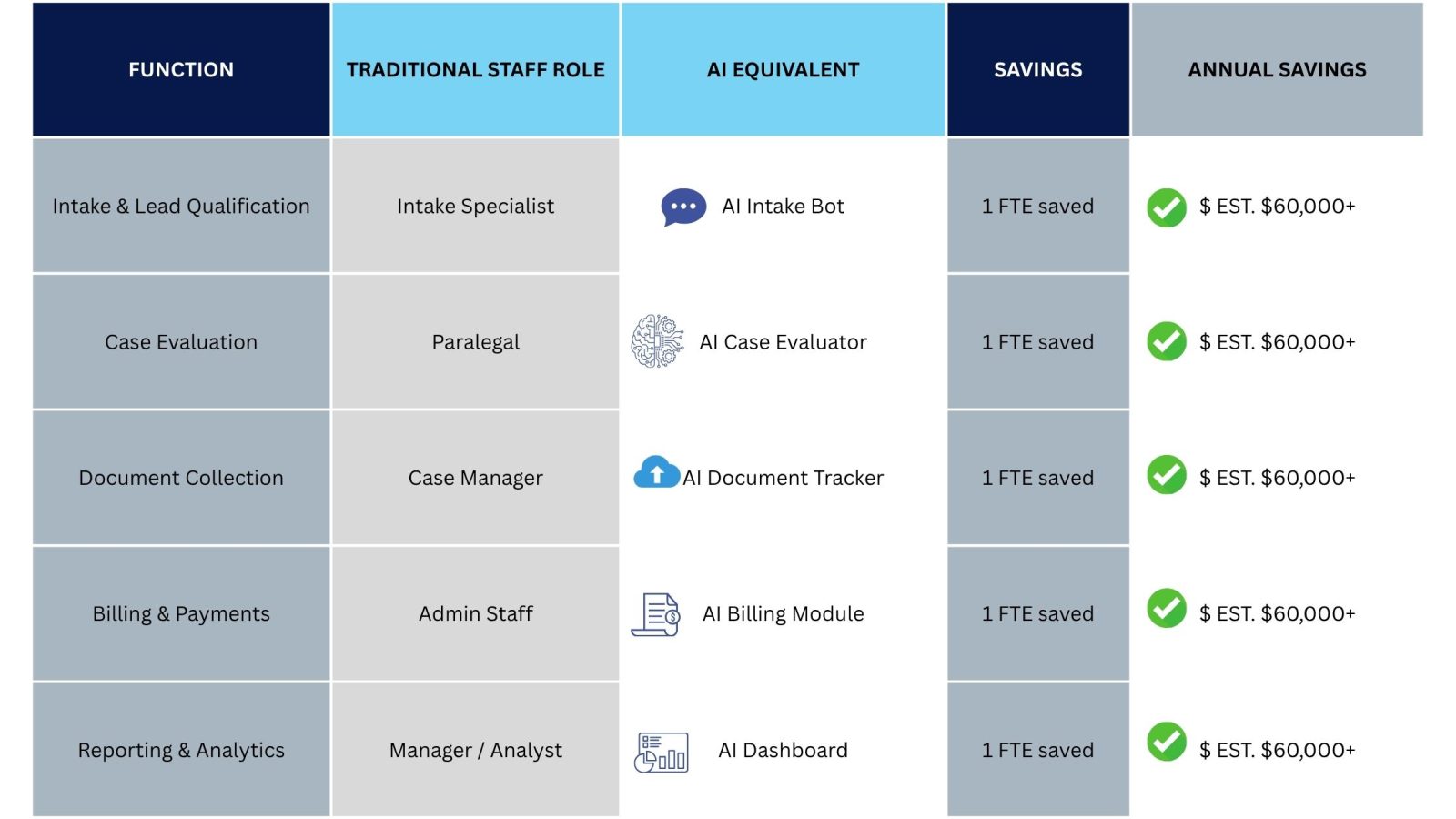
Total Staff Roles Replaced: 4–5
Total Estimated Cost Reduction: Up to 70%
These savings directly increase profitability and give solo attorneys the power to expand their practice without increasing overhead.
Key Benefits of “One Attorney, One AI” Model
✅ Dramatically Reduced Staff Costs (Up to 70%)
AI replaces multiple administrative roles, lowering payroll without sacrificing output.
✅ Increased Operational Efficiency
Tasks are automated end-to-end, reducing delays and boosting overall firm speed.
✅ Consistent, High-Quality Client Experience
AI maintains uniform quality, tone, and accuracy across all communications and workflows.
✅ Unlimited Scalability
AI handles unlimited clients simultaneously, giving solo practitioners the capacity of a large firm.
✅ 24/7 Availability
Unlike staff, AI doesn’t sleep, call in sick, or take vacations. Client intake and processing continue nonstop.
✅ Reduced Attorney Stress
With repetitive work handled automatically, attorneys can focus on the cases that matter most.
✅ Faster Revenue Cycles
AI billing and reminders ensure clients pay promptly — improving cash flow without manual follow-ups.
✅ Data-Driven Growth
Live analytics reveal firm performance instantly — allowing attorneys to scale strategically.
The Future of Immigration Practice
The legal industry is experiencing a shift unlike any before.
Just as email replaced fax machines, AI is replacing the traditional law firm backend.
Immigration attorneys who adopt AI early are gaining an unprecedented advantage — running leaner, faster, and more profitable firms that deliver better client experiences.
The “One Attorney, One AI” model is not science fiction — it’s already happening.
Firms using US Immigration AI are:
- Operating with minimal staff
- Serving more clients
- Reducing overhead dramatically
- Delivering faster, more accurate case results
This is the future of immigration law — where technology doesn’t just assist attorneys, but truly augments and replaces entire operational layers.
A Day in the Life: Before and After AI
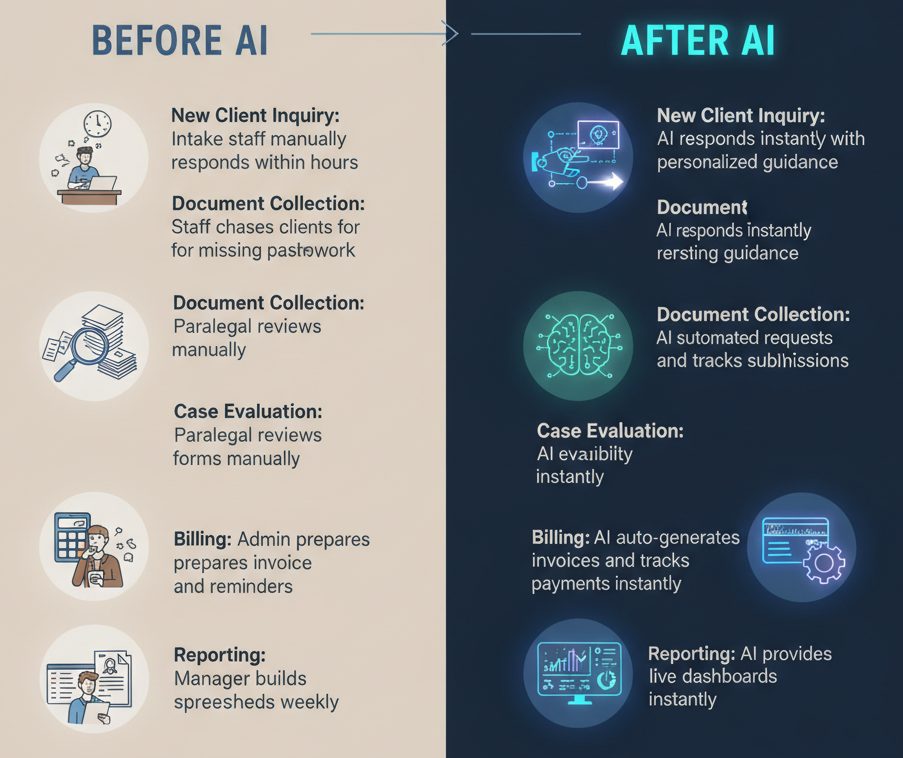
In the “after” version, one attorney controls the entire operation through a single dashboard — without a large team or complex coordination.
Conclusion / CTA
The future of immigration law is not bigger teams — it’s smarter systems.
With US Immigration AI, one attorney can run an entire law firm efficiently, profitably, and independently.
No more chasing staff, managing spreadsheets, or missing deadlines.
Just you, your clients, and a powerful AI platform managing everything in the background — from intake to billing.
It’s time to embrace the new standard in law firm operations.
The One-Attorney, One-AI Model is here — and it’s transforming how immigration firms operate across the U.S.
Book a demo today and experience the next generation of immigration law firm automation.
Discover how US Immigration AI can replace your firm’s administrative backend, cut costs, and give you the freedom to focus on what truly matters — your clients.