
The Efficiency Crisis in Immigration Law Firms — And Why AI Is the Only Scalable Solution

Immigration Law Has an Efficiency Problem
For decades, immigration law firms have relied on the same operational formula: hire more paralegals, add more administrative staff, and hope the workload becomes manageable.
But it hasn’t.
If anything, immigration firms today are more overwhelmed than ever.
Leads pile up.
Intake takes too long.
Clients wait days for responses.
Paralegals are buried in emails.
Attorneys are reviewing documents at midnight.
This isn’t because firms lack talent — it’s because they lack efficiency. Traditional operations weren’t designed to handle:
- Rising case volume
- Higher client expectations
- Instant-response culture
- 24/7 communication
- Heavy documentation
- Constant follow-ups
- Complex workflows
The result is a system held together by human effort — and human limitations.
AI changes that.
Not by helping staff do more…
But by replacing the majority of repetitive, operational tasks entirely.
This article explains why the efficiency crisis in immigration law can no longer be solved by hiring more people — and why AI is now the only scalable, profitable, and sustainable model.
Part 1 — The Hidden Inefficiencies Draining Immigration Firms
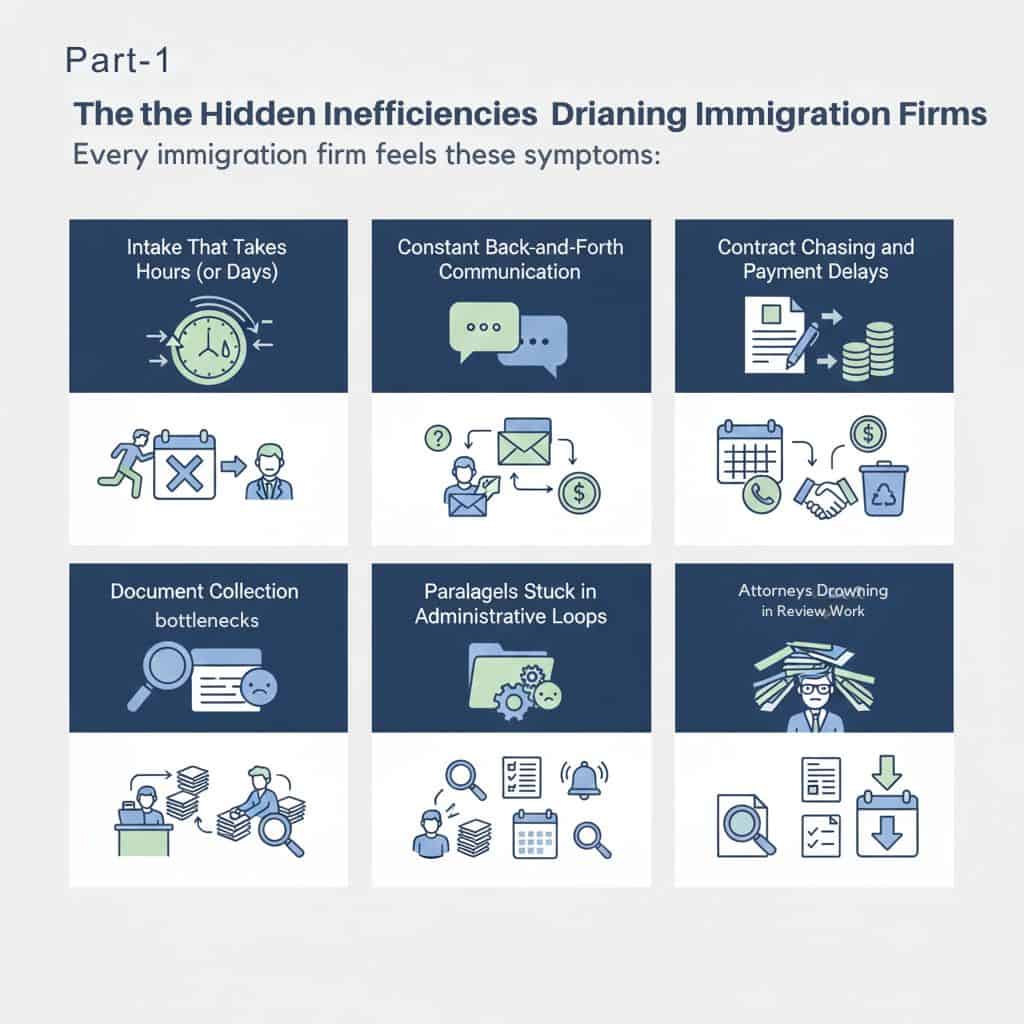
1. Intake That Takes Hours (or Days)
Clients want instant answers.
But intake specialists can only handle one conversation at a time.
Meanwhile, potential clients:
- Get frustrated
- Go to another firm
- Disappear before booking
- Lose momentum
Slow intake = lost revenue.
2. Constant Back-and-Forth Communication
Immigration cases require dozens of messages:
- “What documents do I need?”
- “Where do I upload this?”
- “Is this document acceptable?”
- “Do you need the original?”
- “What’s next?”
Your staff is tied to the inbox, handling the same questions repeatedly.
3. Contract Chasing and Payment Delays
Administrative staff often spend:
- Hours reminding clients to sign
- Calling to confirm details
- Following up on payments
- Re-sending documents when clients lose them
These are tasks that generate zero billable value, yet consume massive time.
4. Document Collection Bottlenecks
This is the biggest operational slowdown in most firms.
Clients procrastinate.
Send the wrong documents.
Upload blurry files.
Forget something critical.
Paralegals spend hours:
- Reviewing uploads
- Rejecting incorrect files
- Asking for replacements
- Tracking missing items
- Organizing evidence
All of this can be automated.
5. Paralegals Stuck in Administrative Loops
Your most skilled team members are doing:
- Data entry
- Status follow-ups
- Reminders
- Evidence formatting
- File organization
- Case updates
They’re doing far less actual legal work and far more operational work.
6. Attorneys Drowning in Review Work
Instead of focusing on strategy, attorneys spend time:
- Cleaning up disorganized files
- Re-structuring case packages
- Chasing missing evidence
- Reviewing unnecessary details
This delays filings and reduces capacity.
Part 2 — Why Hiring More Staff Won’t Solve These Bottlenecks
This is the uncomfortable truth most firms eventually face:
Hiring more staff creates more complexity — not more efficiency.
Each new paralegal, intake specialist, or admin adds:
- More payroll
- More training time
- More internal coordination
- More communication gaps
- More management overhead
- More room for error
You don’t just add a person —
You add another point of operational friction.
In fact, growing teams often slow down firms because:
- Communication lines multiply
- Tasks get duplicated
- Staff rely on each other to follow up
- Work gets siloed
- Documents get lost in the shuffle
- No one has full case visibility
The firm gets bigger…
But not faster.
In immigration law, efficiency does not scale with headcount.
It scales with automation.
Part 3 — The Modern Solution: AI That Replaces, Not Assists
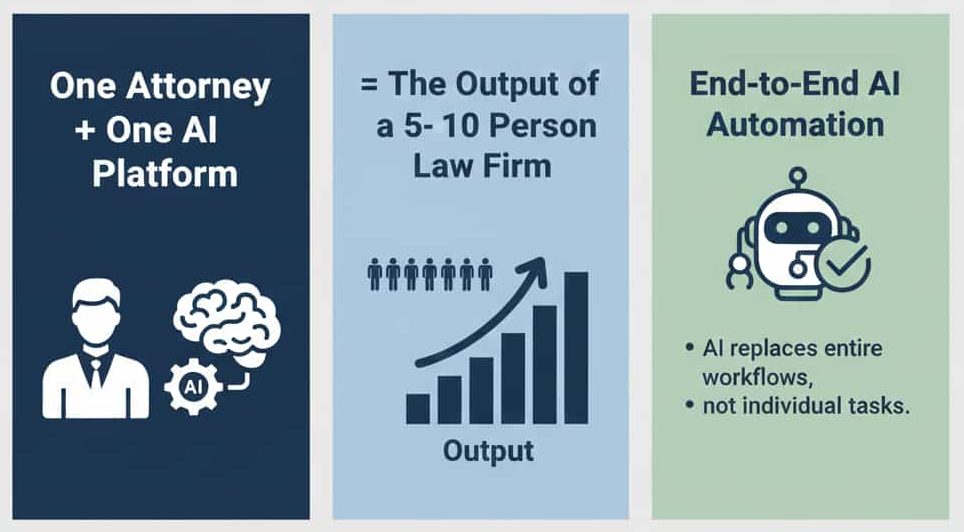
**One Attorney + One AI Platform
= The Output of a 5–10 Person Law Firm**
Instead of adding more employees, firms are turning to AI agents that handle operations end-to-end — the same way multiple staff roles would.
AI replaces entire workflows, not individual tasks.
Here’s how.
AI Intake Agent: Instant, 24/7 Conversion
The AI intake agent:
- Chats with every lead
- Answers questions instantly
- Explains services
- Identifies the correct immigration path
- Pre-qualifies clients
- Quotes your fees
- Sends your attorney-client agreement
- Follows up automatically
- Closes the client
Intake becomes:
Instant → Consistent → Fully automated.
This alone replaces:
- Receptionist
- Intake specialist
- Sales coordinator
AI Contract & Payment Automation
After intake, the AI handles:
- Contract generation
- Sending agreements
- Following up
- Monitoring signature
- Confirming payments
- Updating the client automatically
No human ever needs to chase a contract again.
AI Document Collection & Case Preparation
The most powerful efficiency transformation happens here.
The AI:
- Sends a personalized document list
- Creates the client portal
- Reviews uploads
- Flags missing items
- Detects incorrect files
- Requests replacements
- Organizes everything in a clean, attorney-ready structure
- Drafts the support letter
- Drafts the exhibit list
- Prepares the final package
This replaces:
- Paralegal document review
- Evidence QA
- Case organization
- Admin follow-ups
- Drafting support materials
Your paralegals can finally do higher-level legal work — or you may no longer need as many.
Part 4 — The Numbers Don’t Lie: Efficiency = Profitability
A typical mid-sized immigration law firm spends:
$300,000–$600,000 per year
on operational staff (not including attorneys).
With AI:
This drops to $50,000–$75,000 per year
while increasing total case output.
Efficiency isn’t just about time.
It’s about financial leverage.
AI removes:
- Human bottlenecks
- Human errors
- Human delays
And replaces them with:
- Instant responses
- 100% consistency
- 24/7 coverage
- Unlimited capacity
This is the first time immigration firms can scale without increasing payroll.
Part 5 — The New Reality: Efficiency Is the Competitive Advantage
Immigration clients expect speed.
They expect clarity.
They expect 24/7 responsiveness.
They expect frictionless onboarding.
Traditional firms simply cannot operate at this level without massively increasing staff.
AI-powered firms can.
And the firms adopting this model now are positioning themselves to dominate the next decade.
The Efficiency Revolution Has Started
The immigration law landscape is changing.
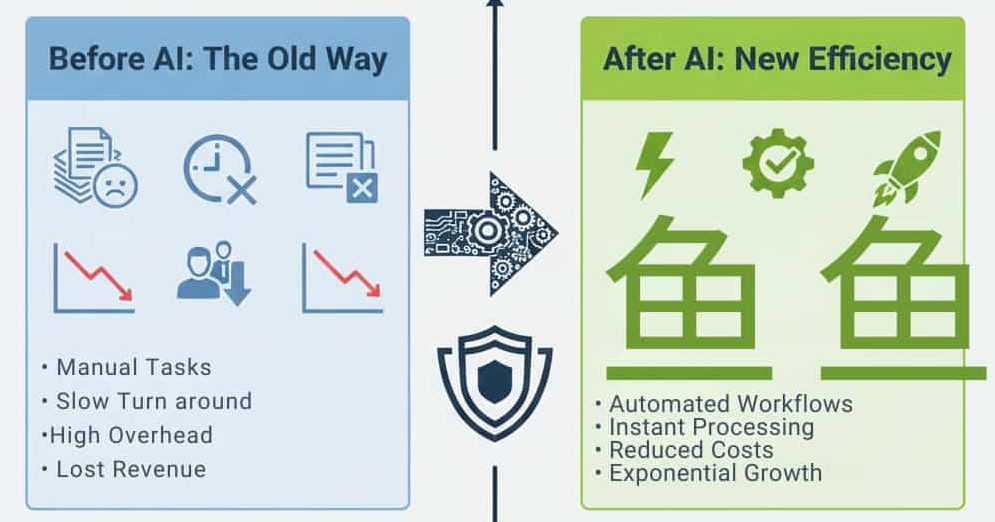
Manual processes → Automated cases
Overworked staff → AI-powered workflows
High payroll → High efficiency
Slow intake → Instant conversion
Paralegal bottlenecks → Continuous AI processing
The firms that embrace this shift will:
- Operate with less overhead
- Process more cases
- Scale without hiring
- Deliver better client experience
- Outperform traditional competitors
Efficiency is no longer optional.
It’s the new foundation of a profitable, scalable immigration law practice.
Ready to Transform Your Firm?
Stop solving efficiency problems with human effort. Start solving them with scalable intelligence.
Learn how US Immigration AI is powering the next generation of profitable, high-efficiency immigration law firms.
Visit Usimmigration.ai today.