
How Immigration Firms Can Cut Costs with AI: The Before & After Transformation

Running an immigration law firm has always required a careful balance between cost efficiency, client satisfaction, and operational speed. But today, the stakes are even higher. With rising client demand, increasing regulatory complexity, and intense competition across the industry, immigration firms are under pressure to operate faster, smarter, and more efficiently — all while keeping costs under control.
For most firms, the biggest expenses aren’t software or marketing. They’re personnel and administrative overhead. Intake specialists, case evaluators, administrative assistants, contract managers, and follow-up coordinators all play essential roles, but they come with significant cost — both financially and in terms of time.
This is where US Immigration AI comes in. Instead of relying on multiple employees to manage intake, evaluate cases, answer questions, send contracts, track signatures, and collect payments, firms can now streamline everything through a single AI-powered system. The result? A dramatic reduction in operational costs and a major boost in efficiency.
This blog breaks down exactly how immigration firms can cut costs using AI, with a clear Before and After comparison to help you visualize the transformation.
Before: The High-Cost, High-Workload Reality of Immigration Firms
Immigration law is document-heavy and detail-oriented. It requires constant communication, repeated follow-ups, and precise workflows. Traditionally, all of this has been handled manually by staff members, which creates large recurring costs and opens the firm up to delays and errors.
Let’s break down the typical structure of a small to mid-sized immigration law firm:
Before: Multiple Staff Members Handling Repetitive Tasks
A traditional immigration firm employs:
- 1–2 Intake Specialists to answer inquiries, gather information, pre-qualify leads, and schedule consults.
- 1 Contract Manager to prepare contracts, send them out, follow up for signatures, and process payments.
- 1 Paralegal or Evaluator to assess eligibility, review client documents, and manage case requirements.
- Additional admin staff for follow-ups, reminders, and communication.
Even a lean team costs a significant amount:
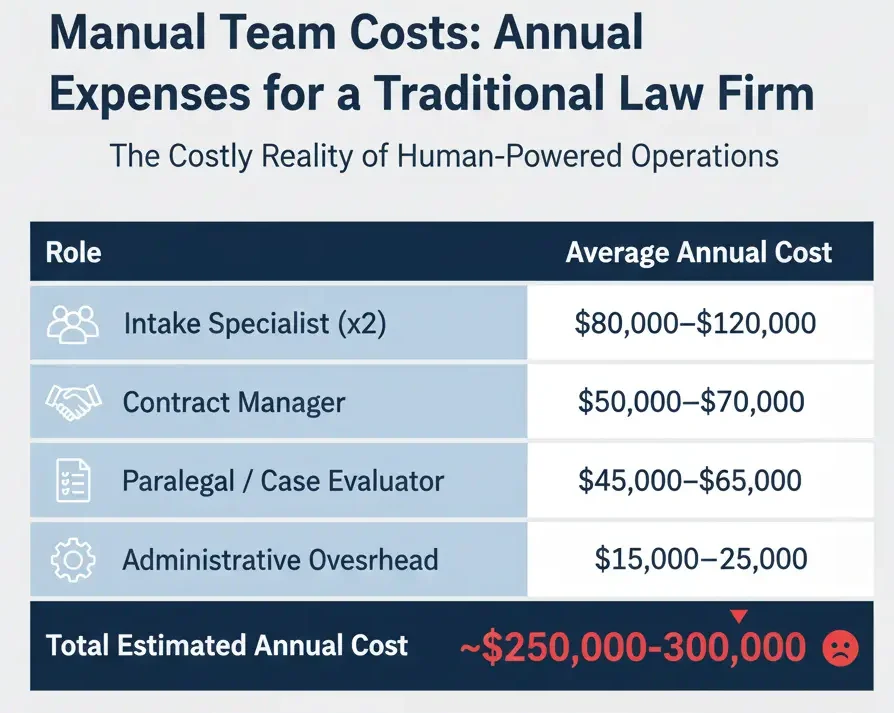
And that’s for a modest-sized firm — many firms spend even more.
But beyond salary costs, manual workflows come with hidden expenses:
❌ Hidden Cost #1: Delayed Responses
When intake staff are overwhelmed, response times slow down. Prospective clients lose interest, feel neglected, or go to another firm.
❌ Hidden Cost #2: Human Error
Misplaced documents, forgotten follow-ups, incorrect evaluations, or contract mistakes all create liabilities and inefficiencies.
❌ Hidden Cost #3: Lost Leads
Every hour a lead waits for an answer dramatically reduces conversion probability.
Manual processes = slower conversion = lost revenue.
❌ Hidden Cost #4: Attorney Burnout
Attorneys often step in to handle tasks that staff miss — taking time away from revenue-generating legal work.
❌ Hidden Cost #5: Over-Hiring
When client volume spikes, firms hire more staff even though most tasks are repetitive and could be automated.
Traditional immigration workflows are expensive not because the work is complex — but because the manual handling of simple, repetitive tasks wastes time and money.
After: AI Automation That Replaces Multiple Roles
Now imagine your firm runs with a single intelligent system that handles:
✔ Intake
✔ Lead qualification
✔ Case evaluation
✔ Contract creation
✔ Contract sending
✔ E-signature collection
✔ Payment automation
✔ Follow-up reminders
✔ Document assessment
That system is US Immigration AI.
Instead of multiple staff performing repetitive tasks one by one, AI performs them instantly, accurately, and 24/7.
Here’s the “After” scenario:
After: AI Handles the Entire Client Journey Automatically
1. AI-Powered Intake & Lead Screening
Before: Staff handle calls, chats, emails, and forms manually.
After: AI answers questions instantly, screens leads, gathers intake data, and qualifies clients for services — while your team stays focused on actual legal work.
2. AI Contract Generation & Signing
Before: Contract managers spend hours preparing, sending, and tracking agreements.
After: AI automatically prepares the correct contract, sends it for e-signature, follows up, and confirms payment — within minutes.
3. AI Evaluation & Document Review
Before: Paralegals manually review documents and conduct eligibility assessments.
After: AI evaluates documents instantly, identifies missing requirements, and organizes information for the attorney.
4. 24/7 Follow-Up & Communication
Before: Staff manually remind clients about signatures, missing documents, or payments.
After: AI sends reminders automatically until everything is completed.
5. Predictable, Low-Cost Operations
Instead of paying $150,000+ yearly for multiple staff positions, firms pay a fraction of that for an AI system that works around the clock.
The Financial Impact: How Much Can Firms Really Save?
Let’s compare traditional staffing vs. AI automation.
Traditional Annual Cost
- Intake Specialists: $80,000–$120,000
- Contract Manager: $50,000–$70,000
- Paralegal/Evaluator: $45,000–$65,000
- Overhead: $15,000–$25,000
➡ Total: $190,000–$280,000 per year
With US Immigration AI
- AI system license & maintenance: ~$5,000–$8,000 yearly
- No need for multiple admin staff
- No overtime, no human error, no delays
➡ Total: $5,000–$8,000 per year
💰 Savings: $180,000–$270,000 per year
The numbers speak for themselves.
Before & After: What the Workflow Really Looks Like
Let’s visualize a real workflow transformation.
Before AI (Manual Process)
Client sends inquiry
⬇
Intake staff respond in 24–48 hours
⬇
Screens client manually
⬇
Prepares contract next day
⬇
Sends contract, waits days for signature
⬇
Follows up for payment
⬇
Paralegal evaluates case the following week
⬇
Attorney reviews findings
⬇
Client onboarding complete after 7–10 days
After AI (Automated Process)
Client submits inquiry
⬇
Instant automatic response
⬇
AI qualifies the client immediately
⬇
AI generates & sends contract in seconds
⬇
Client signs within minutes via e-signature
⬇
AI collects payment automatically
⬇
AI evaluates documents instantly
⬇
Attorney only steps in to finalize review
⬇
Client onboarded in under 24 hours
That is the power of automation.
Why AI Is the Future of Immigration Law Firm Operations
AI isn’t just a trend — it’s becoming the standard for firms that want to scale without adding staff. Here’s why:
1. It Eliminates Repetitive Tasks
70–80% of daily immigration firm tasks are repetitive and rules-based.
AI handles them faster and with fewer errors.
2. It Improves Client Satisfaction
Clients get instant replies, faster onboarding, and better service.
3. It Reduces Staffing Pressure
Attorneys no longer need a large administrative team to stay afloat.
4. It Increases Revenue
Faster onboarding + more leads converted = more clients served.
5. It Makes Scaling Possible
Whether you have 10 inquiries or 500, AI handles the increase effortlessly.
Conclusion: The Smartest Way for Immigration Firms to Cut Costs
Traditional immigration firm operations come with heavy staffing costs, slow processes, and avoidable delays. By contrast, US Immigration AI replaces multiple staff roles, automates the entire intake-to-contract workflow, and delivers a faster, more accurate, and more cost-efficient system.
Before:
- High salary expenses
- Slow onboarding
- Lost leads
- Errors and delays
- Overwhelmed staff
After:
- Minimal operational cost
- Contracts sent in minutes
- Payments collected instantly
- No missed follow-ups
- 24/7 intelligent intake & evaluation
- Attorneys free to focus on legal work
If your firm wants to cut costs, eliminate unnecessary admin roles, improve efficiency, and scale faster — the solution is clear.
Discover how much your firm could save — request a cost analysis from US Immigration AI today.