
From Manual to Autonomous — The Real Cost of Keeping Immigration Work Human
The Hidden Expense of “Business as Usual”
For decades, immigration law firms have operated on the same model: attorneys handle legal work, staff handle everything else. Intake, forms, follow-ups, contract management — all done manually, by people, one client at a time.
It’s the way things have always been done.
But it’s also the reason so many immigration firms are stuck with high costs, slow workflows, and limited scalability.
The truth? “Business as usual” is more expensive than most attorneys realize.
Every manual task — from sending a fee quote to tracking a missing document — carries a hidden cost.
That cost compounds daily. And by year’s end, it can mean hundreds of thousands of dollars lost in preventable inefficiency.
Why Manual Operations Drain Immigration Firms
Manual work feels safe. It’s human, familiar, and flexible.
But in practice, it’s also inconsistent, slow, and incredibly costly.
Here’s how the average immigration firm loses money through manual processes:
- Lost Leads: When intake responses take hours or days, potential clients move on.
- Staff Overlap: Multiple people chase the same documents or clients.
- Delayed Contracts: Manual follow-ups mean clients don’t sign quickly — or at all.
- Human Error: A single missed deadline or form version can derail a case.
- Limited Scale: Every new client requires proportional staff time and payroll.
Even well-run firms lose efficiency to “micro delays” — small tasks that feel minor individually but cost hours each week.
Multiply that by 12 months, and a mid-sized immigration firm can easily lose $100K–$150K per year in wasted labor — even before factoring in salaries.
The True Cost of Keeping It Human
Let’s visualize what “manual” looks like inside a traditional immigration firm:
- The intake coordinator answers calls and types information into spreadsheets.
- The paralegal cross-checks that data for accuracy and form eligibility.
- The admin assistant emails the client reminders for missing documents.
- The case manager manually updates the attorney on status changes.
It’s a chain reaction — dozens of touchpoints just to get one case ready.
Each person adds value, but each also adds time, salary, and potential for delay.
That’s why most firms hit a ceiling: beyond 40–60 active clients, operations start to strain, response times slow down, and errors increase.
It’s not a reflection of poor management — it’s a byproduct of manual dependency.
Autonomous US Immigration AI — A New Operating Model
Now imagine the same workflow, but fully autonomous.
When a new lead comes in through your website, AI intake instantly:
- Responds with a personalized greeting.
- Asks key qualifying questions.
- Determines visa category and eligibility.
- Generates an accurate fee quote.
- Schedules a consultation automatically.
Once the client retains:
- AI contract management sends, tracks, and collects signed agreements.
- AI case management builds a case file, requests documents, and monitors deadlines.
- AI communication keeps clients updated automatically with friendly, professional messages.
No manual data entry.
No chasing clients for missing forms.
No waiting for someone to “get to it tomorrow.”
This is what systems like US Immigration AI deliver — not just automation, but autonomy. The system acts as your full operations department, continuously running in the background while you focus on legal strategy.
The Financial Impact — From Overhead to Opportunity
Here’s how the transformation looks numerically for a typical immigration firm:
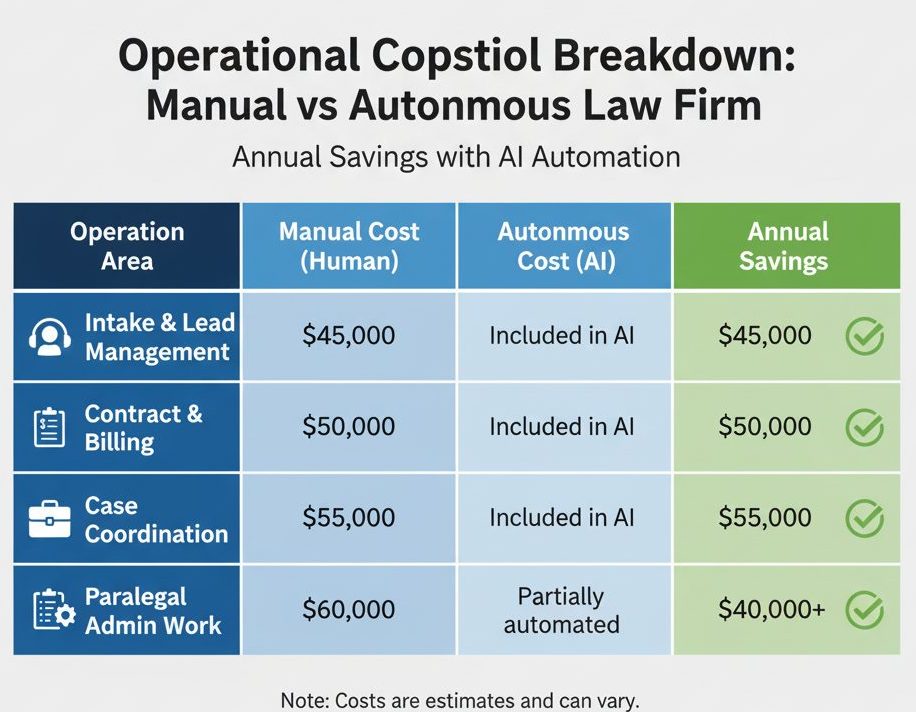
That’s a 90% cost reduction without compromising service quality.
But the bigger shift isn’t just financial — it’s operational.
When every repetitive process runs automatically, attorneys unlock their most valuable resource: time.
The Human Factor — Why AI Doesn’t Replace Lawyers
AI doesn’t practice law — it powers the business behind it.
Attorneys remain the center of expertise and decision-making.
What AI does is remove the administrative drag that limits how many clients you can help.
Think of it like this:
- You stay focused on strategy, client consultation, and complex legal analysis.
- AI runs everything else — intake, communication, tracking, and organization.
In other words, AI isn’t replacing lawyers; it’s replacing inefficiency.
Comparing Workflows: Before and After AI
Let’s look at the same client journey — one managed manually, and one run autonomously.
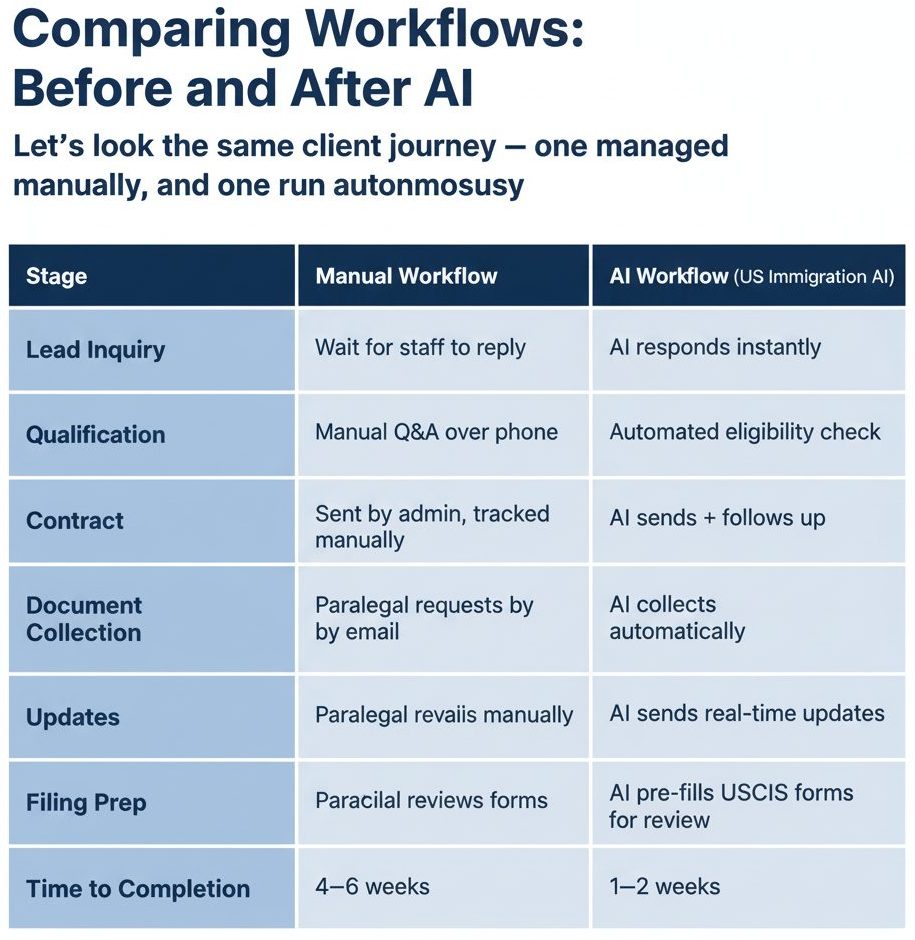
By automating each stage, firms can process 3x the caseload with the same attorney effort — while cutting 70–80% of operating costs.
The Psychology of Letting Go
Many attorneys hesitate to fully automate because they worry:
“What if the system misses something?” or “What if clients prefer human interaction?”
But here’s what’s happening in practice: clients love AI-driven firms.
Why?
Because AI never sleeps, never forgets, and always responds immediately.
Automation doesn’t make service less personal — it makes it consistently professional.
Plus, the attorney remains available for complex discussions.
The AI simply ensures every client feels seen, heard, and updated — automatically.
Why Staying Manual Is the Costliest Decision
Let’s be blunt: staying manual today is the new “overstaffing.”
Every repetitive task handled by a person could be handled faster and cheaper by AI.
Every delay costs money. Every manual entry risks error.
Meanwhile, firms that adopt automation are pulling ahead — faster response times, lower prices, higher client satisfaction, and wider profit margins.
The divide between manual and autonomous firms isn’t just operational anymore — it’s existential.
Within a few years, AI-powered immigration firms will dominate the market the same way e-filing overtook paper forms.
The question isn’t if automation will take over — it’s when you’ll decide to benefit from it.
Security, Accuracy, and Oversight
US Immigration AI was designed specifically for immigration law compliance and security.
It uses encrypted storage, audit trails, and data privacy standards aligned with U.S. legal ethics. Attorneys retain full oversight while the AI executes routine actions under your rules.
That means:
- No data leaks or unauthorized access
- Every message and document is logged
- Every workflow is auditable
In short, you gain automation without losing control — a perfect balance between technology and accountability.
The Compounding ROI of Going Autonomous
Every month your immigration firm runs on AI, your margins grow.
Here’s why:
- Fixed Costs Stay Low: AI subscription remains constant, even as your caseload grows.
- Revenue Scales Effortlessly: You can serve more clients without hiring.
- Staff Redundancy Disappears: No need for overlapping roles.
- Client Satisfaction Rises: Consistent communication boosts retention and referrals.
Within a year, most firms report ROI exceeding 10–15x compared to human-run operations — purely from reduced overhead and increased case volume.
The Future: One Attorney, One AI, Unlimited Capacity
The future of immigration practice won’t be defined by firm size — it’ll be defined by firm intelligence.
A solo immigration attorney with a fully autonomous system can now outperform traditional 5-person teams in both speed and accuracy.
That’s the model driving the next generation of firms — powered by US Immigration AI, which replaces:
- Intake teams
- Admin assistants
- Contract managers
- Case coordinators
All while preserving the one role that matters most: the attorney’s expertise.
The Real Cost of Staying Manual Is Falling Behind
Every hour spent on repetitive work is an hour lost to strategy, growth, and client care.
Every dollar spent maintaining manual processes is a dollar that could have gone to innovation.
By embracing AI autonomy, immigration firms aren’t just cutting costs — they’re reclaiming control of their time, their profit margins, and their future.
The firms that adapt today will define tomorrow’s immigration law landscape:
One Attorney. One AI. Unlimited Capacity.