
Before and After AI Intake: How Immigration Law Firms Transform Client Onboarding

When someone thinks about hiring a law firm, intake is the initial process that happens. This is when the law firm and the person who might become a client first talk to each other. For law firms that help people with immigration this step is very important. It can be slow and wasteful.
Every time someone calls or emails the law firm or fills out a form on their website someone from the law firm has to deal with it. The people who work at the law firm like the intake coordinators, administrative assistants, paralegals and even the immigration lawyers spend a lot of time getting information from clients figuring out if they are a good fit and getting contracts ready.
The client intake process for immigration law firms is really important because it is the step, in helping people with their immigration issues. Immigration law firms must make sure they get this step right so they can provide the service to their potential clients.
Unfortunately, manual intake comes with hidden costs: errors, lost opportunities, slow response times, frustrated clients, and limits on firm growth, and as immigration law firms grow, scaling manual intake workflows requires more staff, more training, and higher overhead, which means overhead cost is higher too.
AI-powered intake changes all of that. It automates repetitive tasks, prequalifies clients, collects data accurately, generates contracts, and delivers attorney-ready cases all while providing a seamless, professional experience for prospective clients.
In this post, we’ll break down the “Before vs. After AI Intake”, showing how immigration law firms can replace multiple staff roles with a single intelligent AI system, reduce costs, and improve client experience.
Before AI Intake: Manual, Fragmented, and Costly
1. Staff-Heavy Workflows
Manual intake requires multiple staff roles to keep the process moving. Typical staff responsibilities include:
- Receptionist: Answer phone calls, respond to emails, collect client information.
- Administrative Assistants: Schedule consultations, send reminders, and manage documents.
- Paralegals: Verify client information, prepare contracts, and assist attorneys.
- Attorneys: Review leads and correct errors, wasting valuable billable hours.
Even a small law firm may employ two to five people just to manage intake, creating a high payroll burden and complicating management.
2. Slow Lead Qualification
Manual screening leads leads is inefficient:
- Staff ask basic qualifying questions to check the eligibility, but the responses may be inconsistent.
- More often than not, attorneys receive unqualified leads.
- Slow response times can frustrate potential clients, who may move on to faster firms.
Example: A client submits an inquiry about a visa type the firm does not handle. The intake coordinator forwards it to the attorney, who spends 10–15 minutes reviewing it, only to realize the lead is unqualified. Multiply this by dozens of leads daily, and the wasted time quickly adds up.
3. High Risk of Errors
Manual processes inevitably produce errors:
- Names, dates, and contact information may be entered incorrectly.
- Documents may be misplaced, misfiled, or incomplete.
- Follow-up tasks are often delayed or forgotten, creating compliance risks.
Each mistake requires additional staff hours to correct, slowing down case initiation and frustrating clients.
4. Limited Scalability
Growth is constrained in a manual system:
- To handle more clients, the firm must hire more intake staff.
- Training new employees adds costs and delays.
- The process remains inconsistent, even with more staff, because humans are inherently error-prone.
Manual intake becomes a bottleneck, limiting firm growth even when demand is high.
5. Frustrated Clients
Client experience suffers when intake is slow or inconsistent:
- Delayed responses to calls and emails frustrate prospective clients.
- Repeated requests for missing information create confusion.
- Poor intake experiences can damage the firm’s reputation and result in lost business.
After AI Intake: Automated, Accurate, and Scalable
1. 24/7 AI-Powered Intake
AI client intake systems can handle inquiries around the clock, across multiple channels:
- Phone, chat, SMS, and email inquiries are managed without human intervention.
- Prospective clients are guided through a structured intake workflow, ensuring all necessary information is collected efficiently.
Unlike a human team that can only work limited hours, AI is always available, increasing client satisfaction and capturing leads that might otherwise be lost.
2. Instant Lead Prequalification
AI screens leads instantly:
- Tailored questions assess eligibility based on case type and visa requirements.
- Unqualified leads are filtered automatically, saving attorney time.
- Qualified leads are forwarded to attorneys complete with all necessary information, ready for review.
Example: Instead of staff spending 15 minutes on each unqualified lead, AI completes the screening in under two minutes, freeing staff to focus on high-value tasks.
3. Automated Data Collection and Document Handling
AI systems streamline the intake process by:
- Collecting client information once and validating it automatically.
- Organizing documents correctly and flagging missing items.
- Reducing human error, ensuring attorneys have accurate data.
All forms, IDs, contracts, and supporting evidence are stored in one secure, centralized location, ready for attorney review.
4. Smart Contract Generation
AI automates contract creation:
- Engagement letters, fee agreements, and service contracts are generated automatically.
- Contracts are sent to clients, signed electronically, and stored securely.
- No staff intervention is needed, reducing delays and errors.
This means attorneys receive fully prepared cases without administrative overhead.
5. Attorney-Ready Cases
With AI intake:
- Attorneys receive complete case summaries, including validated client information, documents, and signed agreements.
- Staff time is redirected from administrative tasks to strategic legal work.
- Cases progress faster, and clients enjoy a seamless onboarding experience.
6. Scalable, Cost-Effective Operations
AI intake allows law firms to scale without hiring additional staff:
- One AI system can replace multiple staff roles: intake coordinators, administrative assistants, and contract preparation personnel.
- Firms reduce payroll, training, and onboarding costs.
- Processes remain consistent and error-free, even as the firm grows.
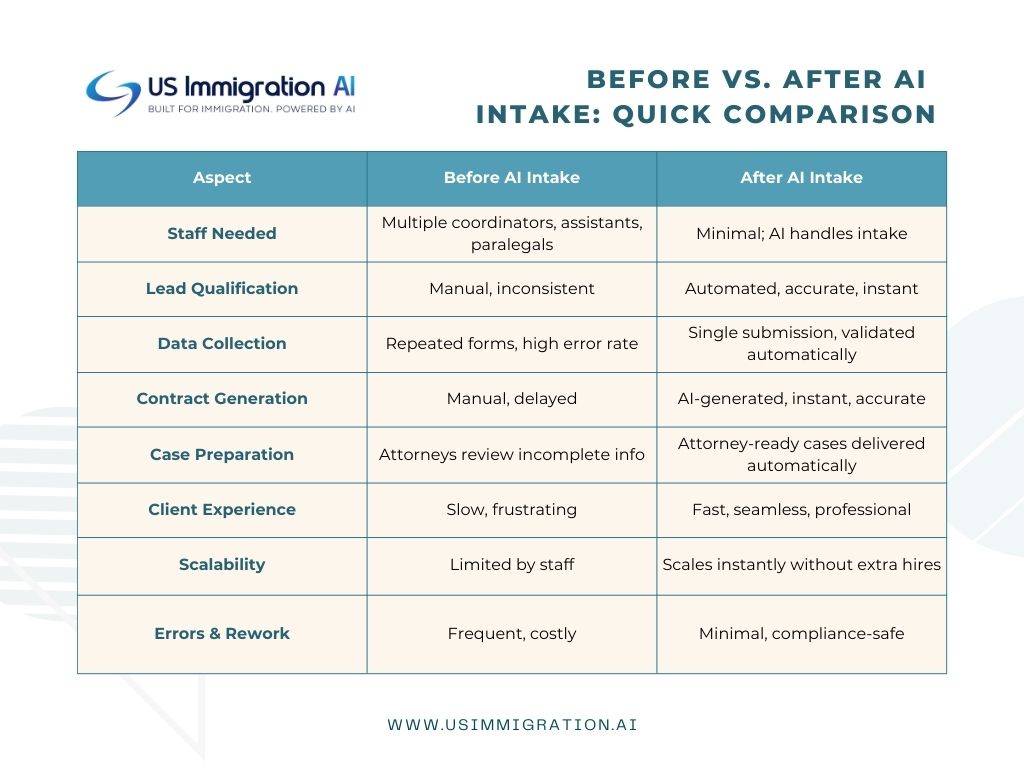
Before vs. After AI Intake: Quick Comparison
Real-World Impact: Numbers That Matter
- Staff Reduction: Firms often reduce intake-related staff by 50–70%.
- Faster Case Starts: AI intake can reduce onboarding time from hours to minutes.
- Higher Conversion Rates: Prospective clients get faster responses, increasing likelihood of engagement.
- Error Reduction: Automated data validation minimizes mistakes in forms and contracts.
- Scalable Growth: Firms can handle double the clients without adding employees.
Why Immigration Law Firms Adopt AI Intake Now
Immigration law is document-heavy, rules-driven, and highly repetitive perfect for AI automation. Firms adopting AI intake gain a competitive edge:
- Operate faster and leaner than competitors.
- Reduce payroll and overhead while handling more clients.
- Deliver superior client experiences with instant, accurate intake.
- Free attorneys to focus on billable legal work instead of administrative tasks.
The question is no longer whether AI works it’s how long firms can afford to operate without it.
Manual client intake is expensive, slow, and prone to errors. AI-powered intake transforms the process by:
- Automating repetitive tasks
- Prequalifying leads instantly
- Collecting and validating data accurately
- Generating contracts automatically
- Delivering attorney-ready cases
For immigration law firms seeking efficiency, scalability, and superior client service, AI intake is no longer optional, it’s essential. Firms that implement AI intake save time, reduce errors, lower costs, and gain a clear competitive advantage.